Generations of Sound: A Conversation Between Paul and Dave Tsien

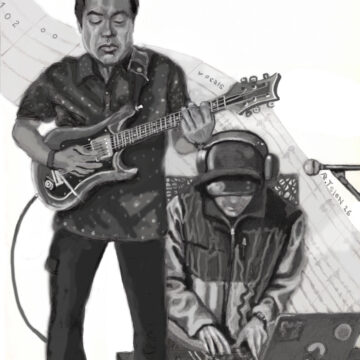
Paul Tsien is an electronic music producer working in experimental rap and ambient music. His work blends emotion, collaboration, and digital production to create layered, atmospheric beats shaped by online music communities. He is currently developing solo projects, artist collaborations, narrative-based music, and film scoring work.
https://soundcloud.com/chinapoet/popular-tracks
https://www.instagram.com/chinapoet
Dave Tsien is a guitarist and lifelong musician whose work has evolved from original songwriting in bands to performing covers and exploring music as a creative outlet. Influenced by classical music, high-fidelity audio, and guitar-driven rock, Dave values sound, melody, and tone. After working a corporate job for 32 years he plans to return to original music and rebuild his home recording studio for future creative work.
https://soundcloud.com/soulgrindstudio/popular-tracks
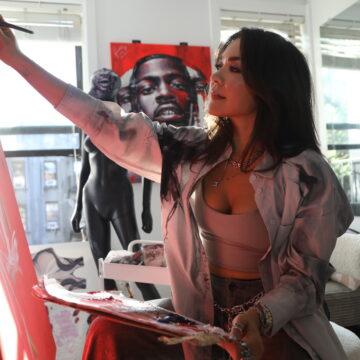
Rebecca Tsien is a New York City–area illustrator and designer specializing in expressive portraits and caricatures. A Parsons School of Design graduate, she creates commissioned illustrations and prints that capture personality, expression, and character through distinctive visual storytelling.
https://www.tsienillustrations.com
Paul Tsien Interview
DT: Okay, to start, where did your love of music first come from?
PT: I think it came from listening to music and enjoying that experience enough to figure out how to do it myself—to reverse-engineer it, in a way. Does that make sense?
DT: Yeah.
PT: It is like taking a scientific-method approach to consuming art.
DT: Sure. How would you describe the type of music you make?
PT: It is very spur-of-the-moment—a reflection of whatever I am feeling at that point. If I am stressed, it is like compressing the totality of that feeling into one small point and making something from it.
DT: So there is a genre this music fits into?
PT: Are you looking for a genre?
DT: Yes. What is the name of that genre, and who do you usually picture listening to your music?
PT: I would say it is primarily in the rap space—or the experimental rap space. The main audience is people like me: kids who grew up online and got into niche interests through online subcommunities. I make weird rap beats for kids on the internet.
DT: So there is a community around this?
PT: Yes. There is a big scene around the shows, the artists, and the conversation surrounding the music as a whole.
DT: Are there hot spots? Is it global, or are there specific hot spots in the United States?
PT: I think it is global. In any major urban environment, there are usually hot spots. New York and Brooklyn have a big community of people working in and consuming this type of music. It is similar in Los Angeles, Chicago, Miami, London, and parts of China, like Shanghai and Beijing.
RT: In China, is there still risk around this kind of music? Is it still considered taboo, or has that changed?
PT: I do not think so. Some of my friends who are more well known in China do not seem to have issues.
RT: So it is more accepted?
PT: Yes. They are going on tour throughout Asia and then coming to the States.
RT: You know what I mean though, because they used to have to do things basically in an empty warehouse…anything that had freedom of expression…
DT: Art…
RT: I guess things have changed.
PT: Yeah, I mean it’s the same as making any music being released today…and you’re talking about anything socially progressive. If you were doing so in the cold war era, they would’ve called you a communist of something.
RT: Yep, yeah. Interesting. It’s interesting that China has progressed you know? That’s cool.
DT: So, what instrument do you play? Or… if it’s not an instrument, how do you usually write your songs?
PT: I play the “computer and keyboard mouse” and click on things (laughing) and um, I have described it as sculpting. I’m just in a DAW with nothing, and I’ll take different elements of different sounds or songs and start putting them together and stripping things away (and adding more stuff and stripping more things away)
DT: So, sounds like that’s the process. What’s the process for how you work with other artists?
PT: Usually everyone is contributing their own independent pieces in steps. We’re all on our computers constantly anyways for work, school, games, etc. Throughout the day we’re sending files back and forth to each other; one person does one thing and another person adds another thing. If we’re making beats, for example, one person makes a melody and sends it to someone else who does the drums, and then we send it to a rapper who writes their verse and releases it.
If we’re in person, one person is working on a melody on their laptop/headphones and the other person is doing another melody on their setup. And then the project files get traded to the opposite person for drums. When I’m at the apartment, we usually have, like, four different people blaring four different projects out of the speakers on their laptop at the same time. We’re all somehow able to figure it out and cut through the noise to get each of those pieces back to another person to work on…like four separate projects at once.
DT: So there’s, there’s the concept of beats and melodies in this genre. And then is there is rap over that? that’s done separately? So are there three elements? Is that right?
PT: There’s a whole fanbase for the producers themselves. Like, I think most of the people at Pitchfork who listen to my music are listening to the production. There are a whole bunch of people who are primarily fans of the rappers, and then there’s a lot who care about both. From the creative side, it’s like two separate bodies of employees on the warehouse floor who work together to put out a cohesive package that is consumed by everybody.
DT: So, what kinds of projects are you working on right now?
PT: I’m working on a solo ambient/instrumental album… I might scrap it; it’s around twenty minutes long at this point. I’m also working on an audio-visual narrative story that has music attached… I might just combine the two down the road. Other than that, there are certain artists who I’ve been working with consistently (ie; Protect, Zel) in the underground rap sphere, and I’m working on the score for my friend’s feature length film that should be going into pre-production soon.
DT: So, film scoring, so how does that differ in the creative process verses how you normally do your music.
PT: I’m making something that can complement and run parallel to a visual element as opposed to making something that must blindly conform around nonexistent vocals. It’s a different thought process, I’m looking at an image and thinking about how I would translate that into sound. I’m also not making it with the expectation that somebody is going to have to fill pickets in with words…
DT: Hmmm.
RT: Is that enjoyable?
PT: Yes, I do enjoy it.
DT: For anyone interested in making this genre of music, what should they do? How should they prepare themselves?
PT: They should go on YouTube and look up tutorials on how to make ambient music… look at their favorite artists and type in “how to make (that artist’s name) type beats.” and do that for five years straight. Talk to as many people as possible, work with as many people as possible. Work with people who are interested in working with you, don’t spend all your energy trying to work with big names, and just keep sharing stuff.
RT: How did Paul’s early interest in classical music, certain classical music, and how did that influence his electronic music? Or did it not?
PT: I think for all the music that I’ve listened to, I can close my eyes and visualize everything that I’m hearing. Classical music compliments that style of thinking. I like very luscious soundscapes–I think it’s interesting to see what you can do with instruments that are playing sustained notes and the different combinations you can create with the limited pitches that we are able to hear. I can take inspiration from a classical song and apply it to rap beats in creating the melody…
RT: Hmm. Interesting.
DT: Ok, that’s it.
Dave Tsien interview
PT: How would you describe your identity as a musician?
DT: I think it’s changed over the years, back in the late 80s I would say I was an artist that would write original music. At that time were trying to get signed by a label. But, as time went on as priorities changed, trying to have a career outside of music and music taking a back seat, I turned in more of a cover band musician and a kind of person who appreciates the music more so than more, say, of an artist trying to do original music.
PT: So when you were trying to focus on original music, was it still in the framework of a band? Like were you always thinking from a perspective of creating something with a group of people that has a coherent identity? Or was there ever a point where it was more solo and independent focused?
DT: Whichever band it was playing in, it was always very focused on a genre, we had a certain sound that we wanted to go after… and the writing was always collaborative. It was between myself and a vocalist, trying to work together. Kind of like your beats and melody, I would come up with the beats and a background on kind of a scratch pad. At the time, that was a 4 track tape cassette tape recorder with a drum machine, and me playing the bass and guitar parts into it. I was trying to create something musically interesting that someone else would do a melody over.
PT: So, why do you think you kind of gravitated towards those roles? Withing the structure of a band?
DT: As a guitar player, unfortunately I was always more into the sounds and the way things sounded sonically, the way the melodies wove around what I would write. I unfortunately never really listened to the lyrics. To this day, of the catalogue of songs we did create back then, I can only remember a few lines of the lyrics to those songs. I don’t listen to lyrics. I listen to more of how the words sonically flow over the top of the music and not the meaning of the words.
PT: Its almost more like an appreciation for the creativity behind the mechanical aspect of the music itself…
DT: Yeah, it’s the sonic sounds and melody, not the meaning of what the person is saying.
PT: That’s interesting, do you think that the same mindset is behind your…like, why you gravitated towards guitars as an instrument in the first place? Because it seems to me like a very mechanical instrument. It’s like a machine that is, I mean I guess all instruments are machines that output notes and can output chords in combinations, but a guitar can require a lot of mechanical ability…um, does that factor into your choice behind that instrument specifically? Or is there another reason?
DT: I think, growing up as an American-born Asian, the first thing that parents do is make their children learn how to play the piano. Not so cool. The guitar was cool. The Beatles had broken up, but they were still very present in my childhood at that time, and it was all formed around electric guitar. So then in the seventies and eighties, guitar players…the technical ability…really shot through the roof. Maybe not as melodic as previously with the Beatles… even today its even taken another step change with the advent of YouTube and seeing people learning from each other… like math rock. Those players are absolutely insane.
PT: Yeah, do you think…um i guess i have two questions that are kind of out of that…i guess first, the do you think that your identity as an Asian American give you any unique experiences navigating the rock world in the later twentieth century?
DT: I think, what’s interesting, there weren’t too many famous Asians playing guitar. When I was doing the original music thing, we were into a heavy alternative genre, and the only notable Asian, was James Iha of the Smashing Pumpkins. Really, not a lot of Asian guitarists at that time.
PT: Interesting, do you think coming from a musical family had any impact on uh the way you approach music or your desire as apart from just not wanting to play piano because it was not cool?
DT: Uh, no (laughing), I mean my father (your grandfather) was always into technology and sound so we always had THE BEST stereo systems. Back then, he had built his own Heathkit all tube stereo, and then after that, we always had very, very high-end, hi-fi audio systems. Mom (your grandmother) had a love of classical music. So, between both parents, between the technical pieces of the gadgetry record players, reel to reels cassette decks, and listening to classical music day and night, that formed a musical basis with a tie to technology. Twelve years of classical piano lessons, maybe that is where a lot of those melodies floating around in my head come from.
PT: Interesting. I guess the other part of what you had said previously, that I wanted to branch off of, was the music industry that you had navigated, when you were most actively trying to get a label deal and work around these business people, what was the biggest lesson that you learned navigating that industry?
DT: Be true to yourself, at the time you really couldn’t just do it on your own. You had to get somebody to your tape heard at a label…be it a lawyer, an agent, a manager…but you had to rely on someone else to get the them (label) to notice you. The labels had all the power. We got on a small deal with one of the major labels. They signed us on the music that they heard on the demos or saw at showcases, but when we laid down the tracks at the studio, they kept on saying “we need to hear the hit, we still don’t hear the hit”. So, we probably went through the better part of a year trying to write what we thought would be a hit. It wasn’t true to the musical direction we were going for. It never came out.
PT: So, having had those experiences and then all of the cover band work since then, and balancing it out with a career, what has been your main drive for continuing to play music and explore music up until today?
DT: Because music is an escape, it’s still fun. It’s just as thrilling as it was playing original music at 2am in NYC or back in high school playing the school dances. It’s the same rush when play live to a crowd, even if it’s not your own music. So now it’s a challenge for me to imitate other artists as closely as possible verses trying to come up with things on my own…. which I still want to do…. but I’m going to save that for retirement, which is coming soon.
PT: That is very awesome. That’s an artform that is very…it’s appreciated, but probably not understood by too many people as far as the motivations behind it. I guess the last question is what is in the future? What are you planning on working on over the next few years?
DT: Well, as I look towards retirement, it’s to get back to writing original music, it’s to reconfigure what used to be my recording studio back into a recording studio instead of a soundproof zoom meeting office for work. So, yeah, I have pre-bought all the materials to reconfigure it, I just need the time to rebuild.
PT: Very nice.
RT: Hey, how has your studio changed? Have you gone from giant mixing boards to more of a digital experience?
DT: Yes! When I first built the studio… while doing both my business career and music career, I had a large format board, rack FX gear, and a number of different tape machines…it has transitioned through analog tape, to digital tape, to external hard drives, and now it’s all inside the box. Completely inside the computer using DAW software, plug-ins and writing to an SSD. So yeah, it has drastically changed. It’s basically like going from a typewriter to a word processor and then moving to app like MS Word with co-pilot. You can cut and paste and use artificial intelligence now.
PT: Do you prefer that? Do you think it makes the…because I think that sometimes the abundance of tools and stuff sometimes makes it a bit too easy to do things, which makes it harder to figure out what’s worth doing.
DT: Most definitely, I think when your equipment is at a minimum level you learn how to literally get the best and most out of that equipment, and it really becomes a differentiator when you master that equipment. Now, with the abundance of plug-ins and everything else that’s out there, there are just too many things to choose from, you never truly get a chance to hone-in in something and really master the use of it.
PT: Good points.
DT: Well, I guess that’s it.
RT: I feel sorry for anybody who has to type this up. (sarcasm)