Margarita Howis

“Portraiture, for me, is not about how someone looks. It’s about what it feels like to become.”
Margarita Howis is an internationally active contemporary portrait artist living between new York and Copenhagen, whose work explores what it costs to become powerful without losing one’s humanity. Working primarily with the human figure, she uses portraiture as a psychological language – a way to investigate identity under pressure, emotional rupture, and the tension between divinity and vulnerability.
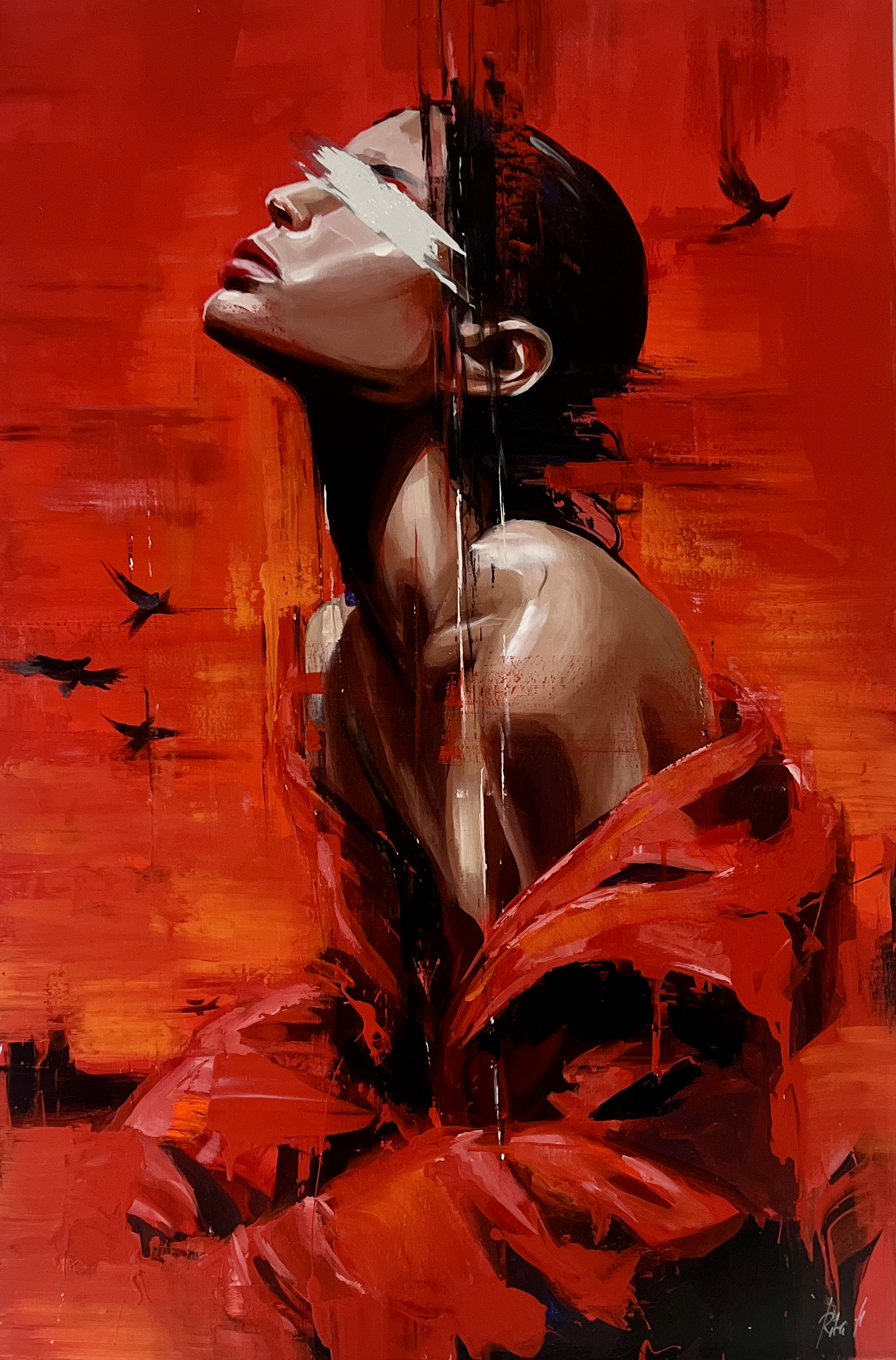
With a background in architecture, Howis brings structural awareness into emotionally charged compositions that balance precision and collapse. Her paintings often feature moments of distortion, smudging, and fragmentation – not as stylistic effects, but as reflections of lived experience. Parts of the face remain sharply defined while others dissolve, mirroring the way identity forms unevenly in real life.
Her work has been presented in solo and group exhibitions across the United States and Europe, including her New York solo exhibition The Currency of Identity and her Miami solo show Eden After Dark with Amarna Gallery, where her work was shown within the broader contemporary context alongside artists such as Retna, Roman Feral and Karen Bystedt.
Beyond traditional gallery settings, Howis’ practice extends into civic, cultural, and philanthropic platforms not as spectacle, but as presence. Through commissioned works, live painting interventions, and foundation collaborations, her work continues to position portraiture as a contemporary emotional record rather than decorative image.
AMM: Your work consistently returns to portraiture, even though portrait painting is often considered conceptually difficult and commercially risky. Why do you continue to choose the human figure as your central language, and how did your visual language develop?
Margarita Howis: I choose portraiture because the human face carries everything – fear, power, longing, survival, desire, tenderness. Abstract painting can suggest emotion, but the human body confronts it. You can’t hide behind it.
I choose portraiture because the human face carries everything – fear, power, longing, survival, desire, tenderness. Abstract painting can suggest emotion, but the human body confronts it. You can’t hide behind it.
I’m not interested in realism for its own sake. I can paint realistically, but realism alone feels emotionally flat to me now. What moves me is tension – when one part of the face holds clarity while another dissolves. When something is precise, yet fractured. That’s how identity feels in real life.
This approach shaped my recent body of work, including my New York solo exhibition The Currency of Identity, where the portraits explored what it costs to become visible especially as a woman and an immigrant. I’ve noticed that when the emotion is honest enough, people don’t relate to the subject – they recognize themselves. Those are the works that find homes.
The distortion came from discomfort. I was painting faces that were technically strong but emotionally silent – beautiful, but empty. I realised I needed rupture. The glitch represents pressure: emotional overload, contradiction, identity split. Parts of us are always polished for the world, while other parts remain raw, unresolved, or breaking.
For me, integrity isn’t about isolation it’s about intention. Painting remains the sun. Everything else becomes a satellite.
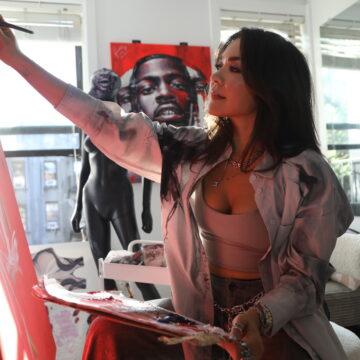
I paint on canvas first. That’s where the emotional language is formed. From there, different formats become extensions of the same energy. Clothes become embodiment. Murals become scale. Live painting becomes presence. Performance becomes transmission.
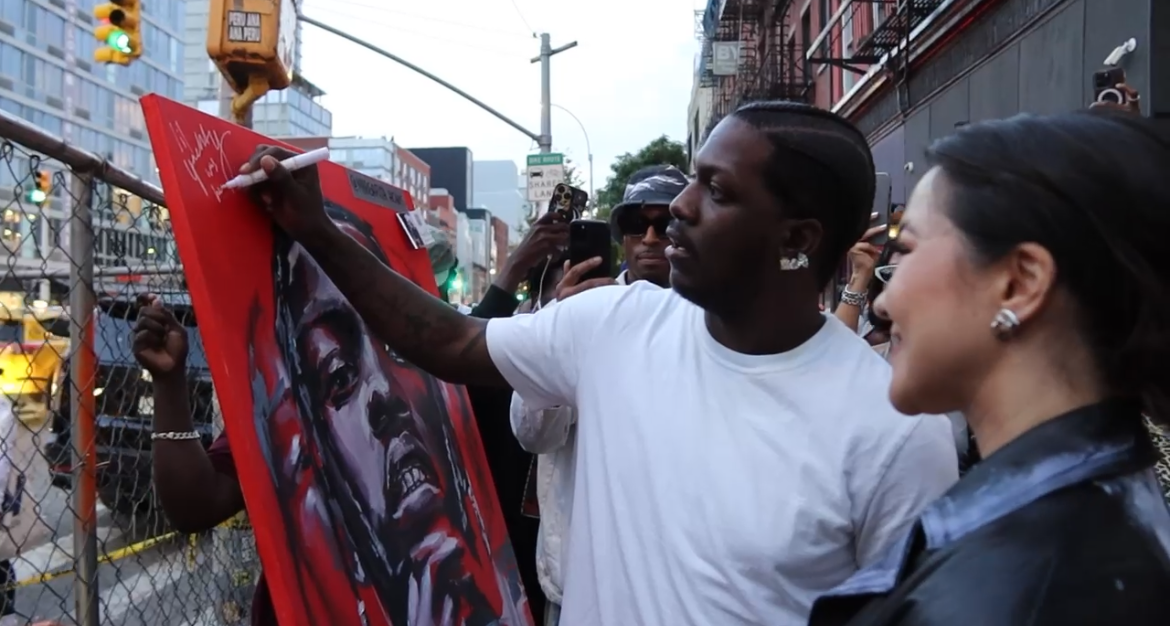
For example, during New York Fashion Week, I created a guerrilla-style portrait of Lil Yachty on the street outside a gallery. It wasn’t about celebrity it was about visibility. About claiming space, claiming voice, and allowing yourself to exist publicly as an artist without asking for permission.
He eventually came, saw the work, signed it, and the moment turned into a shared exchange that was not planned, not requested, but created through presence. That experience reaffirmed something important for me: culture doesn’t always open doors. Sometimes you step forward and let the work speak first.
AMM: You’ve also completed commissions connected to civic and philanthropic initiatives. What role does responsibility play in your practice?
MH: Responsibility became important to me as my visibility grew. When art enters public space, it carries meaning whether you intend it or not.
Being commissioned by the CPR Foundation to paint a portrait of Sheriff Rosie Cordero-Stutz , the first female sheriff of Miami-Dade County , was about more than representation. It was about showing authority through humanity. Strength without hardness. Leadership without erasure of softness.
I’ve also worked with organizations such as Wild Tomorrow Foundation and Lives Amplified, painting in spaces connected to global leadership, conservation, and dialogue. These experiences remind me that portraiture can act as a bridge between power and vulnerability, between institutions and people.
As your practice continues to evolve, what are you consciously building toward?
I’m moving toward coherence – not fitting into a box, but becoming honest about what truly belongs to me.
I don’t believe artists build legacies by knowing early. I believe they build them by staying brave and consistent enough to remain truthful while confused. That’s where I am now.
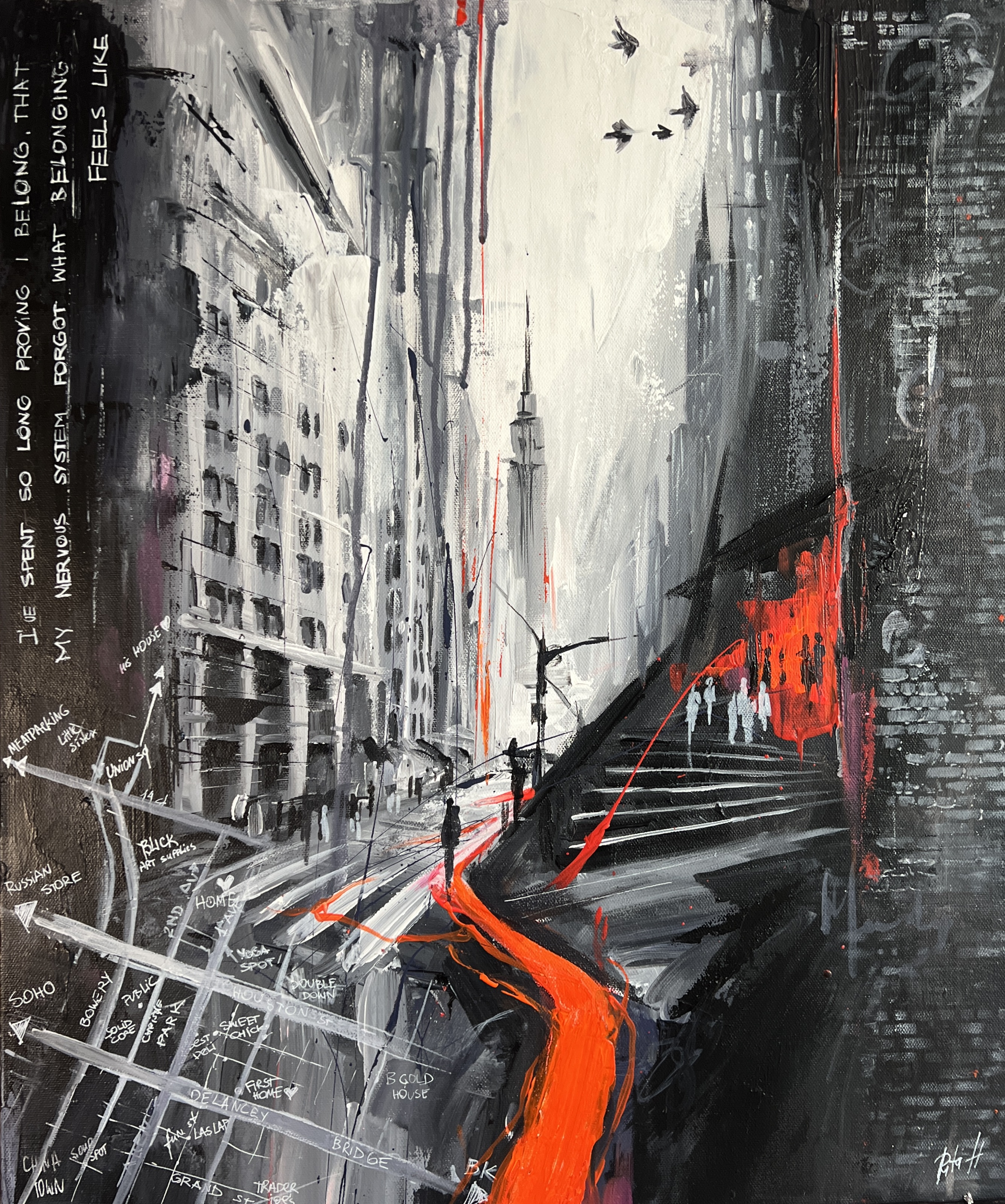
New York has influenced me deeply in this process. Nothing here is clean. Nothing is finished. Everything is layered – posters over posters, dreams over scars, power over fear. It’s existence under pressure. That’s what I’m painting.
My focus now is on building long-term bodies of work, curated exhibitions, and institutional dialogue that allow portraiture to be taken seriously again – not as decoration, but as psychological and cultural record. I’m interested in resonance, identity, power, becoming – and the tension between divinity and human fragility.